
How Much Protein Do You Actually Need?
The old advice of 0.8g per kilo of body weight is based on the bare minimum to prevent deficiency. It is not what’s needed for women to feel strong, maintain muscle, support hormones, and age well.
The functional medicine recommendation is closer to 1.2 to 1.6 grams per kilo of body weight per day and on the higher end if you’re exercising regularly, in perimenopause, or recovering from illness.
For a woman weighing 65kg, that’s roughly 80–105g of protein a day, spread across three meals.
(If you’d like the full breakdown infographic, scroll to the bottom of this email.)
Where should you get it?
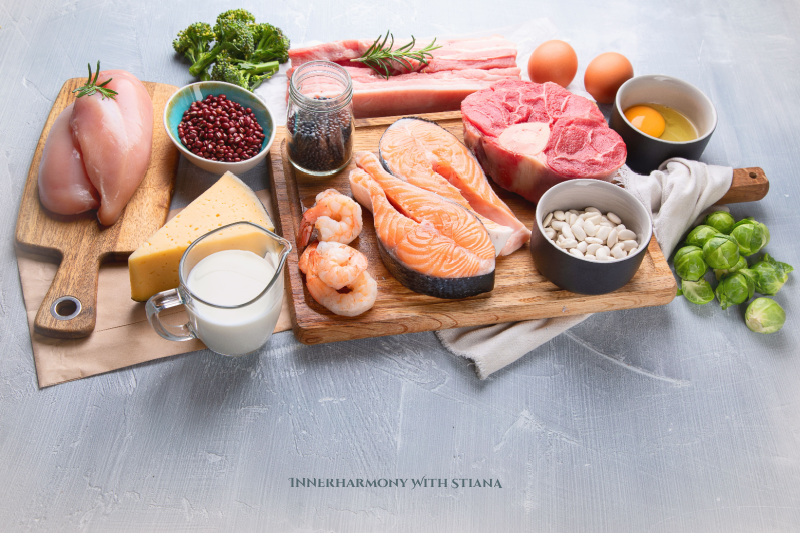
The best sources are whole foods, in this order:
- Wild-caught fish and quality eggs
- Pasture-raised meat and poultry
- Plain Greek yoghurt, kefir, cottage cheese
- Lentils, beans, chickpeas, tofu
- Quinoa, nuts, seeds (smaller contributions but they add up)
- A quality protein powder (whey or plant-based) when you genuinely need it
The goal is 20–30g per meal, every meal. Not “I’ll catch up at dinner.” Your body uses protein in small windows throughout the day — it can’t bank it.
Why none of the above matters if you can’t digest it!
This is the part most of the protein conversation skips, and it’s the part I see derail almost every client who comes to me eating “perfectly” and feeling worse than ever.
Protein doesn’t enter your body as a steak or a shake. It has to be broken down — chewed, denatured by stomach acid, split into amino acids by digestive enzymes, and absorbed through a healthy gut lining — before your body can use a single gram of it.
If any one of those steps is off, the protein you worked so hard to eat largely passes through you.
Here’s what most people don’t know: stomach acid production naturally declines by around 30% by age 40, and pancreatic enzyme output, including pancreatic elastase, tends to follow a similar downward trajectory, especially after midlife. Add in chronic stress (your body simply cannot digest in fight-or-flight) and the hormonal shifts of perimenopause in women and declining testosterone in men, both of which broadly compromise digestive function, and you can be eating beautifully, training well, doing everything ‘right,’ and still feel tired, bloated, losing hair, or not building muscle.
This isn’t a food problem. It’s an absorption problem.
The signs your protein isn’t being digested well:
- Bloating or heaviness after meals (especially after meat)
- Brittle nails, thinning hair, slow wound healing
- Low energy, even when you’re eating “enough”
- Muscle loss/plateau despite training and eating well
- Feeling full for hours after a normal meal
- Acid reflux (often a sign of low stomach acid, not high)
If any of those sound familiar, the next step isn’t more protein. It’s better digestion.
The Thyroid Connection: why this matters even more if you have hypothyroidism of Hashimoto’s
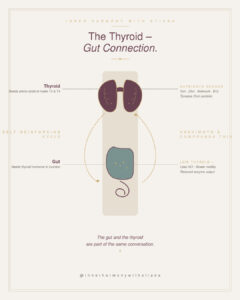
Thyroid hormone influences almost every digestive function we have talked about so far. Adequate T3 and T4 are required for healthy gastric blood flow, hydrochloric acid production, pancreatic enzyme output, bile release, and gut motility. When thyroid function is suboptimal, and this is increasingly common, especially in women, the entire digestive cascade is dialled down.
Research has consistently shown that hypothyroidism is associated with reduced gastric acid secretion. Multiple studies have found that a significant proportion of patients with hypothyroidism have hypochlorhydria (low stomach acid), and many also show evidence of pancreatic exocrine insufficiency. In Hashimoto’s thyroiditis, the autoimmune cause of the vast majority of hypothyroidism in developed countries, this picture is compounded by chronic low-grade gut inflammation, increased intestinal permeability, and disturbed gut microbiome composition. Each of these in turn feeds back to drive further immune activation, in what researchers now describe as the “gut-thyroid axis.”
The downstream effect is significant. Protein digestion suffers. And so does the absorption of the very nutrients required for healthy thyroid function:
- Iron, needed for thyroid peroxidase (the enzyme that synthesises thyroid hormone), requires adequate stomach acid for absorption.
- Selenium and zinc, cofactors for the conversion of T4 to active T3, depend on intact gut function for uptake.
- Tyrosine, the amino acid that is the literal building block of thyroid hormone, comes from dietary protein — which now isn’t being properly broken down or absorbed.
The result is a self-reinforcing cycle. Low thyroid impairs digestion. Poor digestion impairs the nutrient absorption needed to support thyroid hormone production and conversion. Many women with Hashimoto’s are quietly deficient in iron, B12, zinc, and selenium despite “eating well” and find their thyroid medication never quite delivers the energy and clarity they were promised or if they are not on medication that they are still running on empty.
This is why working with the thyroid in isolation rarely resolves the picture. The gut and the thyroid are part of the same conversation.
Peri-menopause and Menopause: when the rules change
For many women, digestion changes meaningfully somewhere in their early 40s, long before their period stops. They didn’t change what they eat. Their workout routine is the same. But suddenly food sits heavily. Bloating becomes routine. Reflux appears for the first time. Sleep slips. And the protein that built muscle effortlessly in their 30s no longer seems to do the job.
This isn’t imagination. It is endocrinology.
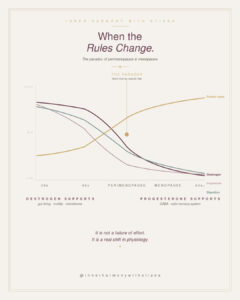
Oestrogen doesn’t just regulate periods. It helps keep the whole digestive system healthy. It supports gastric blood flow, contributes to the integrity of the gut lining, modulates gut motility, and shapes the diversity and balance of the gut microbiome, including a specific subset of bacteria known as the estrobolome, which metabolises and recycles oestrogen back into circulation. As oestrogen begins its irregular decline through perimenopause, all of these systems are affected. Many women experience their first significant digestive symptoms during this window.
Progesterone which falls earlier and more dramatically than oestrogen (mine started to decline in my 30s and were pretty much non existent in my 40s) – plays an additional role. Its metabolites act directly on GABA receptors, the body’s primary calming neurotransmitter pathway. As progesterone drops, GABA tone drops with it, and the nervous system becomes more easily nudged into sympathetic dominance. The cephalic phase fires less reliably – hello digestive symptoms and hello sleepless nights! Cortisol rises. Over time, this chronic activation further suppresses both digestive function and sex hormone production — creating a vicious cycle.
The cruel irony is that perimenopause is the precise window in which protein needs increase. Muscle mass declines naturally, bone density becomes vulnerable, and the body requires more protein, not less, to maintain function. So we ask the body to absorb more at the exact moment its capacity to digest is quietly diminishing.
This is why women in their 40s and 50s so often report feeling like their body has stopped responding to the things that used to work. It is not a failure of effort. It is a real, measurable shift in physiology that is rarely being addressed in conventional care.
My free 30-second pre-meal practice
The protein conversation rarely goes this deep, but it should. Because what we eat is only ever part of the story. How we digest, how we absorb, how our nervous system meets our food, how our hormones and thyroid quietly shape every step of the process, that is where real change lives.
If you’ve recognised yourself anywhere in this post – the bloating after meals, the brittle nails, the muscle that won’t build despite the effort, the digestive shifts that arrived with perimenopause, or the heaviness of a thyroid diagnosis that no one has fully helped you understand, the next step is small.
You can start tonight, before your next meal, with the free 30-second practice I share with every client. It is the doorway. Most women feel a shift within a few meals.
But the deeper work such as looking at your gut, your thyroid, your hormones, your nervous system, your mind as one connected conversation, is where lasting change happens. This is the work I do with women who are ready to stop patching symptoms and start understanding their bodies again.
Two ways to begin:
To start gently: DM me on Instagram with the word DIGEST (@innerharmonywithstiana), or simply reply to my next newsletter with DIGEST, and I’ll send you the free 30-second pre-meal practice.
To go deeper: DM me READY if you’d like to explore working with me. My work specialises in the intersection of digestion, thyroid health (including Hashimoto’s), perimenopause, and the nervous system – for women who are tired of being dismissed, tired of patchwork solutions, and ready to come home to themselves.
You don’t have to keep figuring this out alone.
With you on the journey,

References
- Bauer, J. et al. (2013). Evidence-based recommendations for optimal dietary protein intake in older people: a position paper from the PROT-AGE Study Group. Journal of the American Medical Directors Association.
- Morton, R.W. et al. (2018). A systematic review, meta-analysis and meta-regression of the effect of protein supplementation on resistance training-induced gains in muscle mass and strength. British Journal of Sports Medicine.
- Hurwitz, A. et al. (1997). Gastric acidity in older adults. JAMA.
- Laugier, R. et al. (1991). Changes in pancreatic exocrine secretion with age: pancreatic exocrine secretion does decrease in the elderly. Digestion.
- Mayer, E.A. (2011). Gut feelings: the emerging biology of gut-brain communication. Nature Reviews Neuroscience.
- Bonaz, B. et al. (2018). The vagus nerve at the interface of the microbiota-gut-brain axis. Frontiers in Neuroscience.
- Smeets, P.A. et al. (2010). Cephalic phase responses and appetite. Nutrition Reviews.
- Mulak, A. et al. (2014). Sex hormones in the modulation of irritable bowel syndrome. World Journal of Gastroenterology.


