
The Real Problem Isn’t Just Your Thyroid
Many women are told:
- “Your TSH is ok – even when elevated.”
- “Your T4 is slightly low, but it’s nothing to worry about.”
- “It’s just likely to be stress”
- “Your labs look normal.”
BUT! What is very often missed from the assessment is understanding levels of inflammation.
Inflammation changes how the thyroid functions at multiple levels:
- It can increase TSH
- It can reduce T4 production.
- It can impair conversion of T4 to active T3.
- It increases reverse T3.
- It creates cellular resistance to thyroid hormone.
So even if your labs are borderline “normal”, inflammation may very well be overlooked.
What Inflammation Looks Like in the Body
When inflammation is present, women often experience some or all of these signs:
- Fatigue
- Brain fog
- Cold hands and feet
- Stress intolerance
- Mood shifts
- Slower metabolism
- Gut issues
- Puffiness
- Fluid retention
- Problems with their periods (t00 heavy, painful, irregular …)
- Difficulty sleeping
Why? Because inflammation activates the nervous system into survival mode.
When the body perceives threat:
- It prioritises survival.
- It downregulates metabolism.
- It conserves energy.
- It suppresses conversion of T4 to T3.
- It increases cortisol.
- It disrupts digestion.
Demand outweighs supply. Whilst the body is coping, it’s surviving, instead of thriving.
What Drives Inflammation?
There are a number of things that can drive inflammation. Below are a few of these areas that can impact levels of inflammation. The good thing is that we can mostly influence these.
Chronic Stress
Stress increases:
- Cortisol
- Cytokines
- Oxidative stress
Long-term stress keeps the nervous system locked in fight-or-flight. And the thyroid is highly sensitive to this. It doesn’t just drive inflammation, it also causes incoherence (something I spoke of at length in my latest two blog posts).
Diet
Common inflammatory drivers:
- Sugar
- Refined carbohydrates
- Ultra-processed foods
- Caffeine (especially in stressed individuals)
- Food intolerances
- Even “healthy” foods when gut permeability is present
I have seen many women deal with gut issues and intolerances to healthy foods such as broccoli, kale, onions, garlic.
It’s not the food – it’s the immune system in overdrive.
Gut Dysfunction
The gut houses:
- 70%+ of the immune system
- The conversion site for T4 → T3 (around 20% of T4 is converted to T3 in the digestive tract via microbiome involvement)
If there is:
- Dysbiosis
- SIBO
- Leaky gut
- Chronic infections
Inflammation increases and thyroid function suffers. There is also some evidence that shows that hypothyroid patients with IBS/SIBO often experience malabsorption of Levothyroxine. There is also seems to be an association between hypothyroidism/Hashimoto’s and SIBO.
Environmental Toxins
Examples:
- Pesticides
- Glyphosate (particularly relevant in the U.S.)
- Heavy metals
- Plastics
- Fluoride (can compete with iodine uptake)
- Chlorinated water
The thyroid like the rest of the body is extremely sensitive to toxins. Being aware of your toxic load can help you to mitigate some of the load that the nervous system is carrying.
Iodine Misuse
While iodine is essential, high-dose iodine in autoimmune thyroid conditions can:
- Increase inflammation
- Trigger antibody flare-ups
- Aggravate Hashimoto’s
Blanket supplementation is not always safe. More importantly – this is why getting the right testing done is essential.
Why Supplements Alone Don’t Fix It
Yes, we can use:
- Selenium
- Zinc
- Omega-3
- Curcumin
- Vitamin D
- Magnesium
But if the inflammatory trigger remains:
The system stays dysregulated.
The root must be addressed.
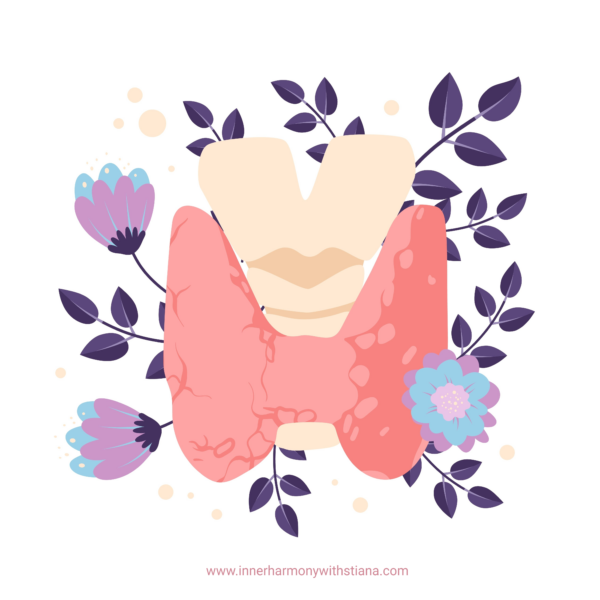
In Summary
If we don’t address:
- Nervous system survival patterns
- Gut dysfunction
- Environmental load
- Emotional stress physiology
- Immune dysregulation
Inflammation continues and the thyroid remains under strain.
If you’re experiencing fatigue, brain fog, cold extremities, or fluctuating thyroid labs — the question is not:
“What medication do I need?”
It’s:
“What is driving inflammation in my body?”
In my 1:1 work, we investigate:
- Full thyroid panels (all the essential markers – this is so so important)
- Gut function
- Stress physiology
- Immune markers
- Environmental burden
- Diet triggers
We don’t guess.
We test.
We individualise.
We treat the root.
If you’re ready to understand why your body is inflamed and how to calm it — book a Clarity & Connection Call so we can talk about the best next steps on your journey to wellness and inner harmony.

References
1. Mancini A., Raimondo S., Di Segni C., et al.
Thyroid hormones, oxidative stress, and inflammation.
Mediators of Inflammation. 2016;2016:6757154.
https://doi.org/10.1155/2016/6757154
2. De Luca R., Davis P.J., Lin H.Y., et al.
Thyroid hormones interaction with immune response, inflammation and non-thyroidal illness syndrome.
Journal of Endocrinological Investigation. 2021;44:1385–1394.
https://doi.org/10.1007/s40618-020-01451-1
3. Peeters R.P.
Non-thyroidal illness: to treat or not to treat?
Proceedings of the Nutrition Society. 2006;65(4):422–428.
https://doi.org/10.1079/PNS2006509
4. Fliers E., Bianco A.C., Langouche L., Boelen A.
Thyroid function in critically ill patients.
The Lancet Diabetes & Endocrinology. 2015;3(10):816–825.
https://doi.org/10.1016/S2213-8587(15)00225-9
5. Boelen A., Kwakkel J., Fliers E.
Beyond low plasma T3: local thyroid hormone metabolism during inflammation and infection.
Endocrine Reviews. 2011;32(5):670–693.
https://doi.org/10.1210/er.2011-0007
6. Knezevic J., Starchl C., Tmava Berisha A., Amrein K.
Thyroid–gut axis: How does the microbiota influence thyroid function?
Nutrients. 2020;12(6):1769.
https://doi.org/10.3390/nu12061769
7. De Vito P., Incerpi S., Pedersen J.Z., et al.
Thyroid hormones as modulators of immune activities at the cellular level.
Thyroid. 2011;21(8):879–890.
https://doi.org/10.1089/thy.2010.0429
8. Peckham S., Lowery D., Spencer S.
Are fluoride levels in drinking water associated with hypothyroidism prevalence in England?
Journal of Epidemiology & Community Health. 2015;69(7):619–624.
https://doi.org/10.1136/jech-2014-204971
9. Ferreira M.K.M., et al.
Association between fluoride exposure and thyroid disturbance: A systematic review.
PLOS One. 2024.
https://doi.org/10.1371/journal.pone.0301911


